What Happens When Buildings Start Making Security Decisions With Biometric Access Control in Saudi Arabia?
Can a building know who should enter?
Yes. But biometric access control goes further than recognising faces or fingerprints. Find out how Saudi buildings are improving their security by making better access decisions through biometrics with Smart Finger.
What if a building could recognise who is entering, not just check what they are carrying?
Security requirements of modern buildings in Saudi Arabia are changing. In common, conventional access methods such as cards and PINs primarily verify credentials. They don’t necessarily verify the person using them. On the other hand, biometric access control is a technology that verifies an individual’s unique biological characteristics before granting access. The Saudi Arabian biometric access control market is valued at USD 451.9 million in 2025 and is projected to reach USD 1,465.6 million by 2034 (Source: Vocal).
Common biometric methods such as fingerprint, facial recognition and iris recognition are becoming popular in Saudi Arabia. Such methods matter more in environments where access must be controlled according to identity, role, location and permission level. More than a security check, buildings need systems and access control devices capable of making more informed access decisions.
Smart Finger helps you experience the technology behind access control solutions in partnership with global brands such as Suprema, Salto, Virdi and HID Global.
Why Saudi Buildings Are Turning to Biometric Access Control
A locked door can stop an intruder, but a smarter access control system can determine whether the person at the door should enter in the first place.
Saudi Arabia is transforming with modern infrastructure. The kingdom sees the development of corporate offices, commercial buildings, residential developments, hospitals and educational institutions. Moreover, these buildings are operating with sensitive data that needs a strong access management system to protect.
What are the limitations of conventional access methods?
Sometimes users may lose keys or thieves may duplicate them.
Users can misplace or share their cards.
PINs may get disclosed sometimes.
An automated access control system that is stronger than conventional methods is needed in this context.
How does biometrics address the identity gap?
Certainly, a fingerprint or face is directly associated with the individual. This creates a stronger connection between person, identity, permission and entry. Furthermore, biometric systems can support:
Restricted area access
Employee entry and exit
Visitor management
Time-based permissions
Multiple security zones
Access records and monitoring
In addition, biometric door access control technology can reduce dependence on physical credentials without necessarily eliminating other authentication methods. Here comes the concept of layered security. It means biometrics can work alongside cards, PINs, surveillance and an RFID access control system. Ultimately, the objective is not merely to automate door locking, but to create a more controlled and traceable security environment.
But recognising a person is only one part of the equation. The real security question is whether that person is authorised to enter a particular space.
Deploy the suitable biometric access control system in your facility.
Call Smart Finger at +966 56 997 2277 or drop an email at [email protected] for further information.
Redefining What “Authorised” Really Means
Being recognised does not automatically mean being authorised. This distinction is where intelligent access management begins.
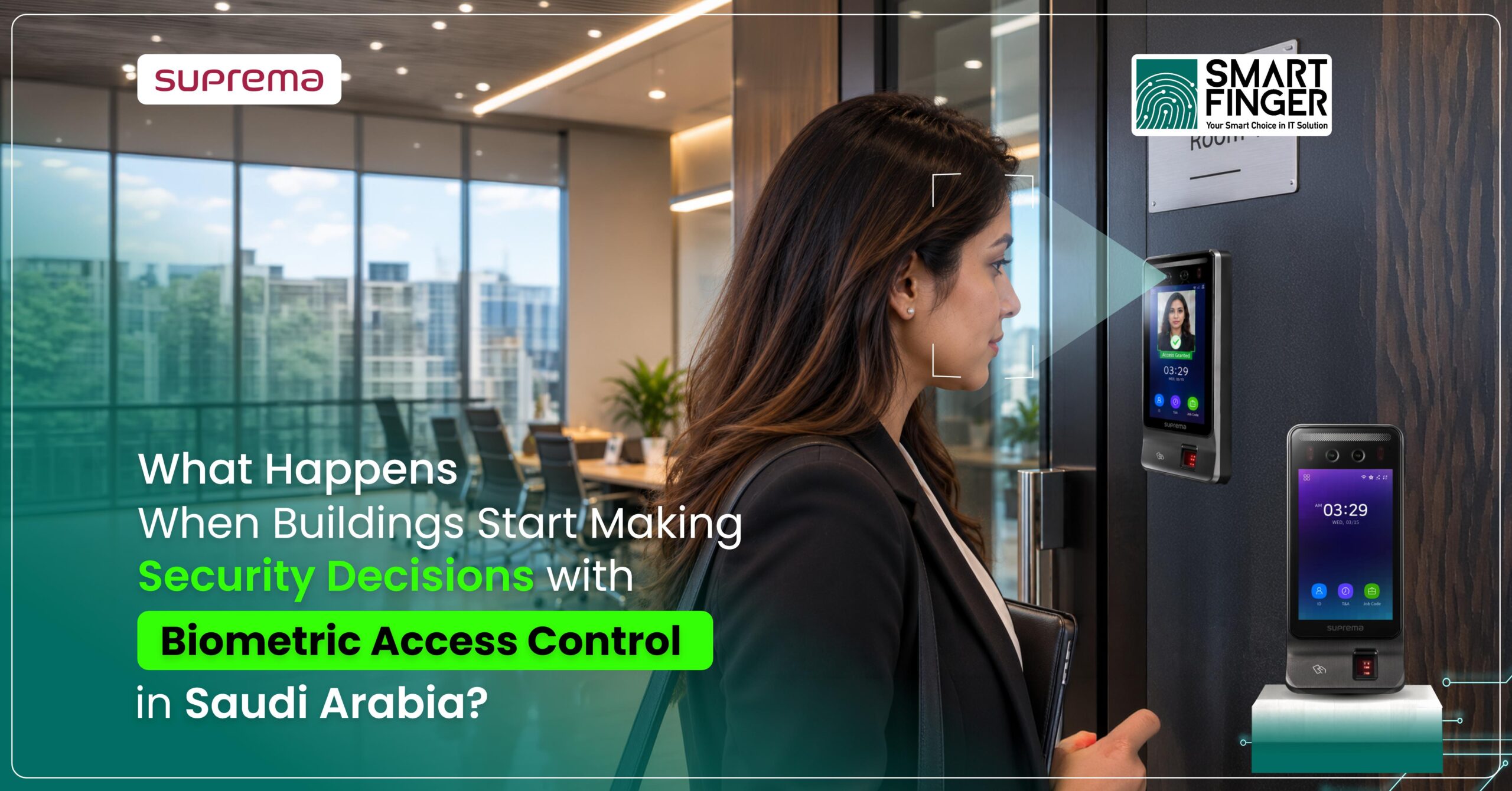
Commonly, traditional access follows a simple logic. If the credential is present, the door can be unlocked. On the other hand, a smart security system introduces another layer. When a person approaches, the system verifies his identity and checks permission status. If everything is perfect, the person can enter the premise. Otherwise, access will be denied.
Moreover, authorisation can depend on who the individual is, which area they are trying to access, when they are entering and what permissions have been assigned to them. Different kinds of biometric access control solutions are popular today.
- Fingerprint access control
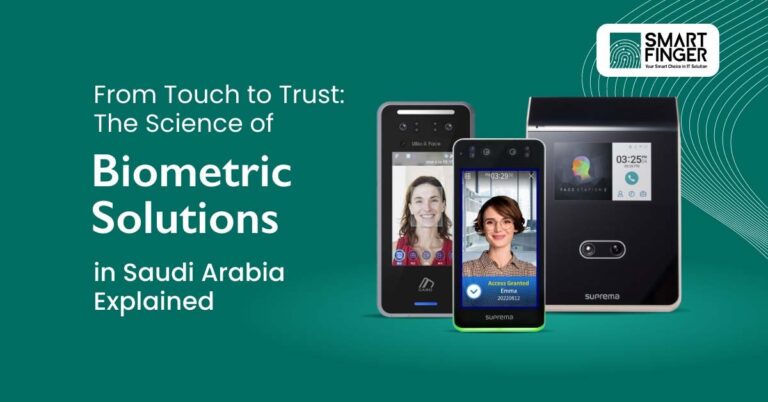
This access method uses an individual’s fingerprint characteristics for identity verification. It is suitable for employee entrances and controlled internal areas. Also, this method can create individualised access records. The brand Suprema offers a fingerprint access control system. e.g. BioEntry W2, BioEntry P2
- Facial recognition access control
Generally, this method uses facial characteristics to verify one’s identity. It can provide a contactless authentication experience. Furthermore, this method is particularly relevant for environments where speed and convenience are important. e.g. Suprema BioStation 3 Max, Virdi UBio-X Face Premium, Virdi UBio-X Pro 2
- Iris-based recognition
It uses distinctive patterns in the eye for identity verification. This method is important for environments that require stronger identity verification. e.g. Virdi UBio-X Triple
Biometric and non-biometric methods can work together. A card access control system and a door access control system represent a broader category covering technologies used to regulate entry. Also, a card system verifies possession of a credential. Therefore, ‘authorised’ should not simply mean someone has a card. It should mean the right person with the right credentials or biometric features at the right location at the right time with the right permission.
Choosing Smarter Biometric Access With Smart Finger
The value of biometric security is not determined by the scanner alone, but by how intelligently the entire access environment works together.
We provide biometric access control and security technologies in Saudi Arabia. With more than 11 years of experience, we help Saudi businesses implement the security systems they need in their facilities. The expertise and local knowledge we possess enable us to offer the needed help for businesses.
Mainly, businesses should assess their requirements before selecting an access control security system technology. They must consider the number of users, the number of entry points, required security level, type of facility, restricted areas and integration requirements. By analysing these factors, we can help businesses evaluate different authentication approaches, rather than treating one biometric technology as suitable for every building.
Moreover, we provide solutions for fingerprint authentication, facial recognition, RFID or card-based access and door access systems. It is important to integrate biometric access with broader security infrastructure where required.
Our goal is not simply to provide automated entry. Instead, we are committed to enabling controlled, intelligent and accountable access in modern Saudi buildings.
Deploy the suitable biometric access control system in your facility.
Call Smart Finger at +966 56 997 2277 or drop an email at [email protected] for further information.
FAQ
The use of biometric access controls helps Saudi organisations ensure that only authorised individuals gain entry into certain areas within a building which is better than keys or card access methods. It uses facial features and fingerprints for verification.
A fingerprint access control system authenticates the person by their fingerprint. It can be safer because a card can be lost, stolen or passed to someone else.
Facial recognition access control can provide quick, contactless identification at a building’s entrance. Its feasibility is determined by a number of factors including security, environment, privacy issues and system integration.
Yes. Biometric access control can be combined with an RFID access control system or card access control to make a multi-level authentication process. You can install the best method that fits your security needs and policy.
We can help in analysing the facility types, user categories, number of access points, security level and integration needs before purchasing an access control solution, including biometrics and other technologies.