
Can your Evolis printer do more than print a card?
Absolutely. But the real question is whether it can handle your smart credentials, security protocols and future demands. Discover what to check before choosing your next card printer.
Imagine a Riyadh tower at 8:30 a.m. Staff tap phones, press fingers to scanners and swipe badges. But down in the security office, an ID card printer sits beside a stack of blank cards. Is it outdated, or act as the quiet backbone of the system?
The market suggests biometrics are growing. IMARC Group reports Saudi Arabia’s biometrics market at USD 54.7 Million in 2025. Also, it projects USD 241.6 Million by 2034, a 17.41% annual growth rate. Yet fast growth does not retire the card. Many biometric readers still pair a fingerprint with a card for two-step checks.
Smart Finger is a supplier of security and identification technology in Saudi Arabia with more than ten years of expertise. Facilities managers, HR teams and school administrators all face the same question. Which credential belongs where? Find it with Smart Finger.
Are ID Cards Still Relevant Alongside Biometrics and Mobile Access?
Short answer: yes. But the longer answer is more interesting, because the card’s job has changed.
First, think of access as three layers:
- Biometrics prove who is standing at the door.
- Mobile passes make entry quick and contact-free.
- The card tells everyone else who you are, at a glance.
Imagine your phone dies at the gate. Who lets you in? A guard cannot read a fingerprint template. A visitor has no enrolled phone. However, a colour printed photo and name can solve these problems.
Also, cards work as the fallback. Fingers may be cut, wet or covered in dust, particularly on construction sites, while employees may occasionally leave their phones at home.
Then comes privacy. Saudi Arabia’s PDPL became effective on 14 September 2023. SDAIA enforces it, and full enforceability began a year later. Also, the law lists biometric data among sensitive categories, so check your obligations with legal counsel.
One option is a template-on-card approach. In this, the fingerprint template is stored on a credential instead of a central database.
Mobile access is real, too. HID showcased its Mobile Access technology at Intersec Saudi Arabia 2025, demonstrating how smartphones and smartwatches can function as access credentials. Additionally, these passes ride on NFC or Bluetooth Low Energy, and Android handsets use host card emulation. Additionally, facilities that use mobile credentials often retain physical cards for visitors and contractors.
The real question is not cards or biometrics. It is how the two share a door.
Commonly, a biometric access control setup reads the card first, then checks the finger. Moreover, employee identification cards equipped with MIFARE DESFire chips securely store the cryptographic keys used during authentication. Furthermore, Smart Finger offers readers as well as RFID access control cards. Readers and cards come from one supplier, so compatibility questions have one owner.
Need the right ID card printer for your Saudi workplace?
Call Smart Finger at +966 56 997 2277 or drop an email at [email protected].
Which ID Card Printer Fits Your Saudi Workplace? 5 Brands to Know
Ask these three questions: how many cards per day, how many sides, and what encoding? Commonly, a clinic issuing a few dozen cards each week has disparate requirements from a contractor onboarding hundreds of workers. Each ID card printer below gives a different answer.
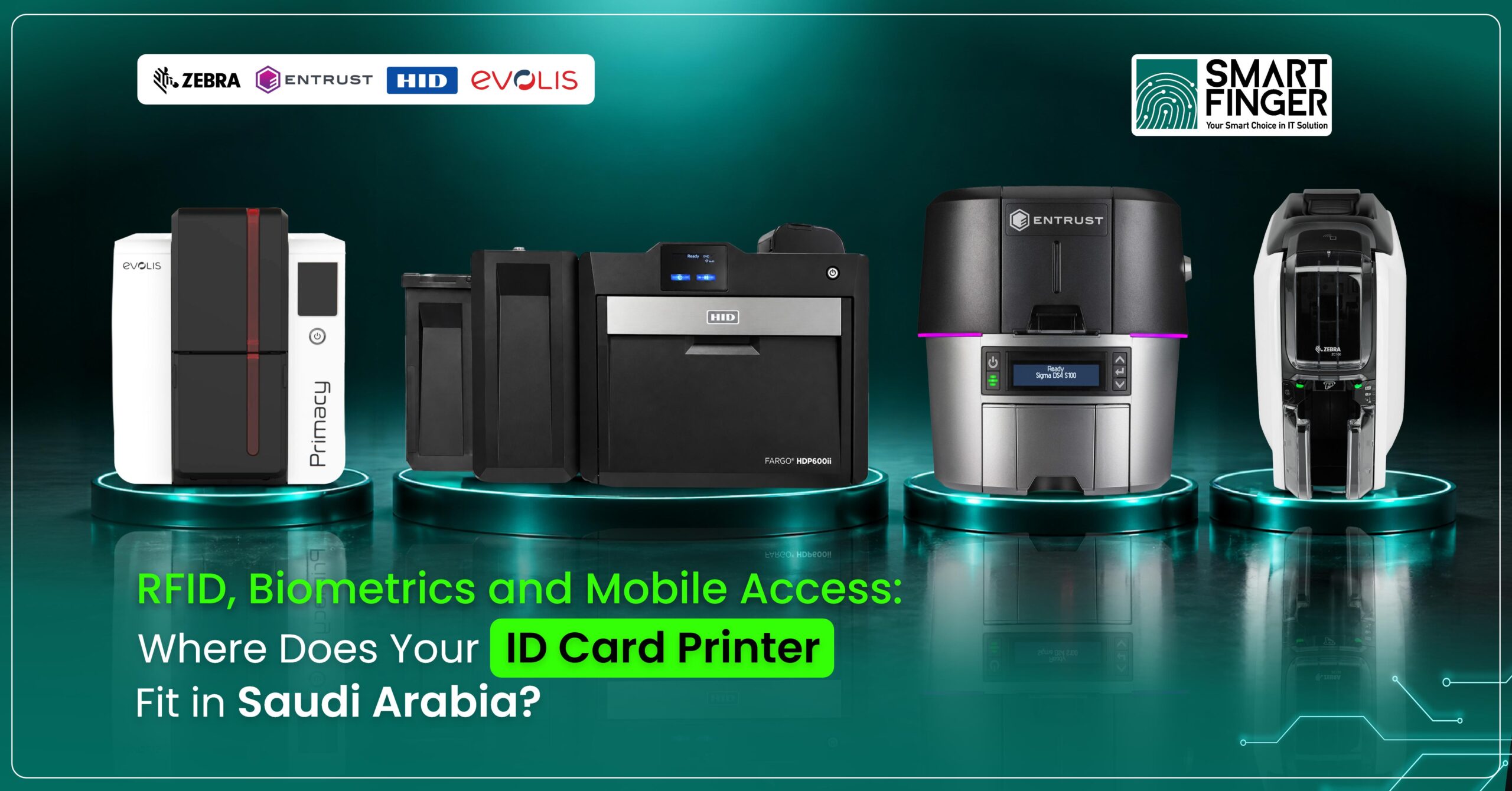
- Evolis – Compact and sleek, with sharp dye-sublimation output. The Evolis ID card printer can be used in front desks that issue cards on demand.
- Zebra – Built tough and fast. A Zebra ID card printer handles busy gate offices, where cards roll out all day.
- Entrust – Made for high volumes with strong encoding and security features. Enterprise programmes, such as banks and campuses can benefit from an Entrust ID card printer.
- HID Fargo – An HID card printer pairs naturally with HID readers. Retransfer models print edge to edge on cards.
- Heidi – Useful for small and mid-sized teams. A Heidi card printer comes with a simple setup that suits schools and clinics.
(Features vary by printer model.)
Now match the machine to the job:
- An employee ID card printer in single-sided mode is plenty for front-only photo badges.
- Need rules or QR codes on the back? A dual sided ID card printer will be capable of doing it.
- Chips inside? A smart card printer with a contactless encoder handles RFID card printing and encoding in one pass.
- Dusty yards and harsh sun? Lamination guards the print against wear and fading.
Ribbon choice matters too. A YMCKO ribbon prints full colour with a clear overlay panel. Ultimately, Smart Finger is a trusted supplier of Evolis, Entrust, Heidi and Zebra, with HID Fargo also in the range. We enables you to compare options in one conversation, without looking for separate vendors. More importantly, always test a sample print on your own card stock first.
How Smart Finger Supports Credential Management in Saudi Arabia
Growth exposes weak credential habits fast. Here is a hypothetical: a Saudi contractor opens its third regional office. Each facility buys different readers, different cards and a different printer. Also, nothing talks to anything else.
Smart Finger takes an integrated approach to credential management, covering every stage from enrolment to access verification.
The chain, in practice:
- Enrolment: Live scanners and passport scanners capture the required identity information.
- Issuance: On-site card printers produce employee ID cards to meet the organisation’s identification requirements.
- Encode: RFID cards carry the chip.
- Authentication: Access control readers validate credentials at entry points to verify authorised access.
- Access Control: Turnstiles, speed gates and parking barriers use the same credential system to manage access across different entry points.
Open standards keep that chain flexible. OSDP can encrypt the link between reader and controller. Furthermore, older Wiegand wiring sends data unprotected.
Back to our contractor. With a standardised card format and printer range in place, a new office can be equipped through straightforward deployment rather than a complete system redesign.
Lifecycle matters as much as hardware. Lost cards must be revoked quickly. Contractors need expiry dates. Leavers need their access cut on their last day. Choose software that logs every issue and revocation, so audits stay painless.
Local support counts when a print head fails or a gate stops reading. Before buying, ask one question: will this card, reader and printer still work together in three years? Smart Finger’s team can review your site plan and recommend a matching set. That single question saves painful replacements later.
The Card Still Has a Job to Do
Cards, fingerprints and phones are not rivals. They are teammates with different strengths. The best setups give each one a clear job.
Mobile credentials will keep spreading, and biometric readers will keep improving. Yet someone will still need to hand a new joiner a badge on day one. That moment shapes how seriously staff treat security.
Before your next purchase, do four things:
- List every door, gate and visitor type.
- Decide what happens when a phone or finger fails.
- Pick one card standard before you pick a printer.
- Check your data handling against PDPL duties.
The right ID card printer then becomes an easy call. Smart Finger can walk you through the options, from compact desktop units to high-volume enterprise models. With us, businesses across Saudi Arabia can experience professional ID card printing.
Need the right ID card printer for your Saudi workplace?
Call Smart Finger at +966 56 997 2277 or drop an email at [email protected].
FAQ
Both put photos and text on plastic cards. “Badge printer” usually points to staff or event passes. An “ID card machine” often describes a unit that also encodes chips or magnetic stripes.
Yes. A standard model only prints. An RFID printer adds an encoder that writes data to the chip inside the card, so printing and programming happen together.
At one controlled entrance, such as a server room, yes. Across a campus with visitors and contractors, most sites keep security cards alongside fingerprints or faces.
The common size is CR80, which measures 85.6 x 54 mm. Almost every desktop printer, holder and lanyard slot is built around it.
Price depends on brand, print speed, double-sided printing and encoders. Ribbons and blank cards add running costs. Smart Finger can quote against your daily volume. Call us or use the enquiry form.