
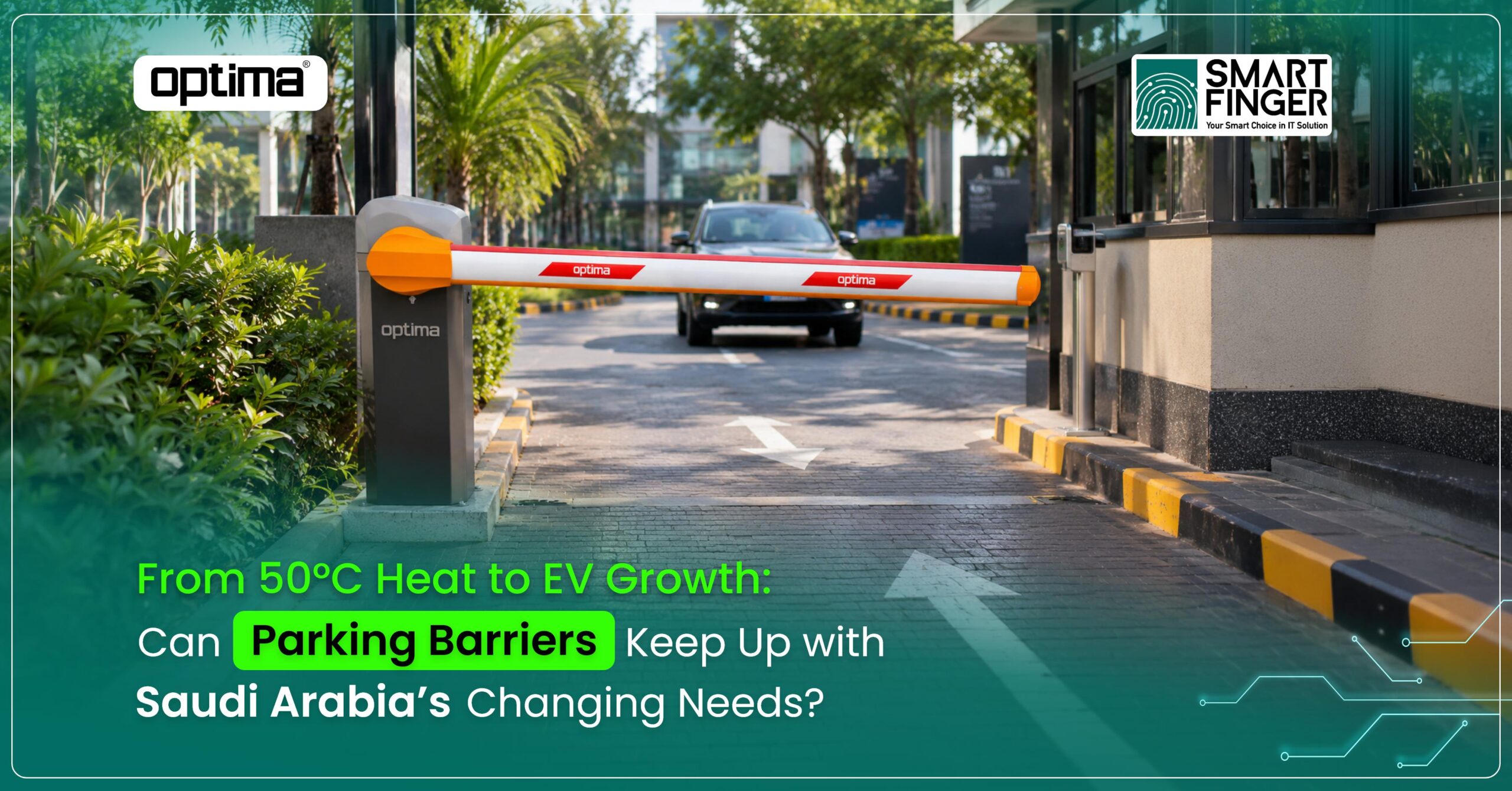
Can parking barriers withstand 50°C heat while keeping EV charging bays secure?
The right system can do both. Discover how heat-resistant hardware, smart access controls and EV-ready parking solutions help Saudi facilities prepare for changing demands. Read the full blog to learn more!
In Saudi Arabia, an office tower entrance can face scorching conditions, with asphalt temperatures rising as the mercury nears 50°C. At the entrance, a boom arm lifts for the hundredth time in an hour, and nobody notices. Ultimately, nobody ever notices parking barriers until one stops halfway.
Now add a second pressure. Saudi Arabia wants 30 percent of Riyadh’s vehicles to be electric by 2030. Also, the state-backed charging operator plans 5,000 fast chargers across 1,000 locations by the same date. Every one of those chargers sits in a bay that a passing driver may try to borrow.
So can your entrance hardware survive the heat and guard the charging bays? Smart Finger believes it can. Certainly, the answer depends on choices made long before installation day. Here is what those choices look like, and why they matter now. Think of it as a practical field guide for facility managers.
Can Parking Barriers Maintain Performance During Saudi Arabia’s Hottest Months?
The National Center for Meteorology has forecast highs of 45°C to 50°C across several regions this summer. Moreover, Al-Ahsa recorded 50°C, and the agency expected summer 2026 to run hotter than normal.
Steel Can Handle the Heat, but Electronics and Motors Cannot
Inside every barrier, a motor, a controller and a set of sensors share one sun-baked cabinet. Commonly, heat thins lubricants, ages plastics and pushes motor windings toward their limits. Moreover, when a unit overheats, it shuts down, usually at the worst moment depending on the system.
Consider a hospital gate handling 600 vehicle movements a day. Each lift and drop adds heat. A unit built for milder climates may trip its thermal protection by mid-afternoon. The arm freezes. Ambulances queue behind a stuck boom.
Moreover, specification sheets show whether a product can cope. Look for these:
Duty cycle: How many openings per hour the motor can sustain.
IP rating: Protection against fine dust, which sandstorms deliver in volume.
Rated temperature range: The ceiling, not the best-case figure.
Finish: Powder-coated surfaces and UV-stable parts resist fading and cracking.
Safety gear: Infrared safety sensors can keep the arm off the car.
Smart Finger supplies parking barrier systems made from weather-resistant, heavy-duty materials. Also, our team handles on-site configuration, so each unit is tuned to the entrance rather than the catalogue. That matters for parking lot barriers serving shopping centres, where afternoon queues test everything at once.
Furthermore, maintenance deserves a line in the budget. A quarterly check of the gearbox, springs and sensor lenses catches small faults early. Dust on a lens can mimic an obstruction and halt the arm for no reason.
Get in Touch with Smart Finger for Reliable Parking Barrier Solutions in Saudi Arabia.
Call us at +966 56 997 2277 or drop an email at [email protected]
How Can Parking Barriers Prevent Unauthorised Use of EV Charging Bays?
Walk through any busy parking lot and you will spot the problem. A petrol car sits in a charging bay while its owner shops. Also, an EV driver circles twice, then leaves.
Painted signs rarely fix this. Moreover, people ignore them, and nobody can patrol every bay.
But you can, however, guard the zone. Certainly, parking barriers at the entrance of a dedicated charging area turn a polite request into a firm rule.
Picture a Jeddah apartment tower with eight shared chargers. By 7 a.m., ordinary cars fill the nearest bays. But residents who bought EVs for those chargers get nothing. So add a barrier and a plate whitelist, and only registered vehicles enter.
Credentials decide who passes. Mainly, most parking access control systems combine three:
RFID cards or tags: Residents tap in, and long-range tags let approved cars roll through.
ANPR: A camera reads the number plate and checks it against the approved list.
Mobile app control: A visitor books a slot and receives a one-time pass.
Inside the zone, parking lot barricades such as bollards and wheel stops protect individual bays. In addition, a fast-closing arm and presence sensor limit tailgating, where a second car slips in behind an approved one.
Furthermore, overstays are the quieter problem. A fully charged car that stays put blocks the next driver. Entry and exit logs reveal dwell time, so managers can set limits and spot repeat offenders.
Smart Finger’s centralised interface handles that from one screen. Managers assign permissions, review logs and automate workflows. Connected to an automated parking system, the same rules apply across every entrance. Ultimately, that is what smart parking looks like in daily practice: rules that run themselves.
How Smart Finger Addresses the Changing Demands of Saudi Parking Infrastructure
Saudi car parks face change from two directions. Heat sets the physical limits. Also, electrification is rewriting who parks where.
The second shift is still early. A 2026 global electric mobility index placed the Kingdom 30th of 31 markets and called its EV sector nascent. That sounds discouraging, yet it holds a clue. Sites built now will serve EV drivers who have not arrived yet.
Equipment bought today must adapt to tomorrow’s rules. Smart Finger’s offering is built around that reality:
Tailored configuration: Setups differ for residential, commercial and industrial sites.
Layered upgrades: Start with simple vehicle restriction, then add credential layers as demand grows.
Easy integration: Devices work with existing access control systems and software, so nothing gets ripped out.
Local support: Installation, on-site configuration and technical support come from us with over ten years’ experience.
Imagine a gated community in Riyadh. Phase one adds parking gate barriers at the main entrance. Also, phase two registers resident EVs and opens a separate charging zone. Smart parking solutions work best when they grow in stages. Start with the barrier, then connect it to a wider parking lot management system as the site matures.
Remote operation and central logs turn scattered gates into one parking management system. Parking automation also frees guards from lifting booms by hand, so they can watch the premises instead. Smart parking systems are only as reliable as the barrier at the front door. Parking management gets simpler when every gate follows one rulebook.
So can parking barriers keep up with Saudi Arabia’s changing needs? Yes, when they are specified for 50°C, wired for EV zones and supported locally.
Get in Touch with Smart Finger for Reliable Parking Barrier Solutions in Saudi Arabia.
Call us at +966 56 997 2277 or drop an email at [email protected]
FAQ
It depends on the model. Check the manufacturer’s rated operating range against local peaks near 50°C. Also compare duty cycle and IP rating. Smart Finger’s team can share rated figures for each unit.
Control the entrance to the charging zone, not just the bays. Use RFID cards or plate recognition to admit registered EVs. Bollards and wheel stops add physical protection inside the zone.
Often, yes. Smart Finger’s devices work with existing access control systems and software. Before buying, confirm controller compatibility and the communication method your current system uses.
A quarterly inspection is a sensible baseline. Clean sensor lenses, check the springs and gearbox, and test the manual release. Busy sites with heavy traffic may need visits more often.
Ask for rated temperature and duty-cycle figures. Ask which credentials the unit supports, such as RFID, plate recognition or mobile control. Confirm who handles installation, on-site configuration and technical support.