
Can one unauthorised person slip into your secure building unnoticed?
Modern turnstile gates close this security loophole by ensuring every entry is authorised, every movement is monitored and every entrance stays better protected.
Saudi Arabia is accelerating its digital transformation. In this context, businesses are rethinking how they identify employees, visitors and authorised personnel. As part of Vision 2030, the use of digital identities through Absher, Tawakkalna and Nafath is increasing.
28 million+ digital identities were issued through the Absher platform as reported by the Saudi Ministry of Interior in February 2025. So the kingdom is focusing on combining physical cards with digital credentials.
But does having a digital printing system mean a physical ID card printer is becoming unnecessary? Not quite. Each serves a different purpose in today’s workplace.
Physical ID Cards vs Digital Credentials and Where Each Fits in Modern Workplaces
Digital ID cards can verify who you are online. But PVC ID cards can help determine where you are authorised to go. This is where the difference matters.
Physical ID cards
Normal ID cards include employee photographs, names, job titles and department details. They also act as visible identification for employees, visitors and contractors. A card printing machine can issue access cards for office doors, restricted areas and attendance systems. Moreover, these are suitable for hospitals, universities and corporate offices.
Digital credentials
We can store and access digital identity through smartphones. This enables QR-based verification and mobile authentication. Mainly, this feature offers convenient identity verification without carrying additional cards. Furthermore such cards are useful for remote verification and digital transactions.
Sometimes people may use both physical and electronic identities. Physical cards allow gaining access and identifying employees physically, while electronic identities help to gain access remotely and verify identity electronically. Simultaneously, contactless cards allow for quick authentication at compatible readers.
When both identity formats serve different purposes, the next challenge is making physical credentials more intelligent. This is where smart card printing becomes important.
Upgrade your organisation’s identity management with Smart Fingers ID card printing solutions.
Call us at +966 56 997 2277 or drop an email at [email protected].
Why Smart Card Printing Matters for Secure and Connected Identity Management
An ID card may look like a simple plastic badge, but what sits inside it can determine how securely an organisation manages workplace access.
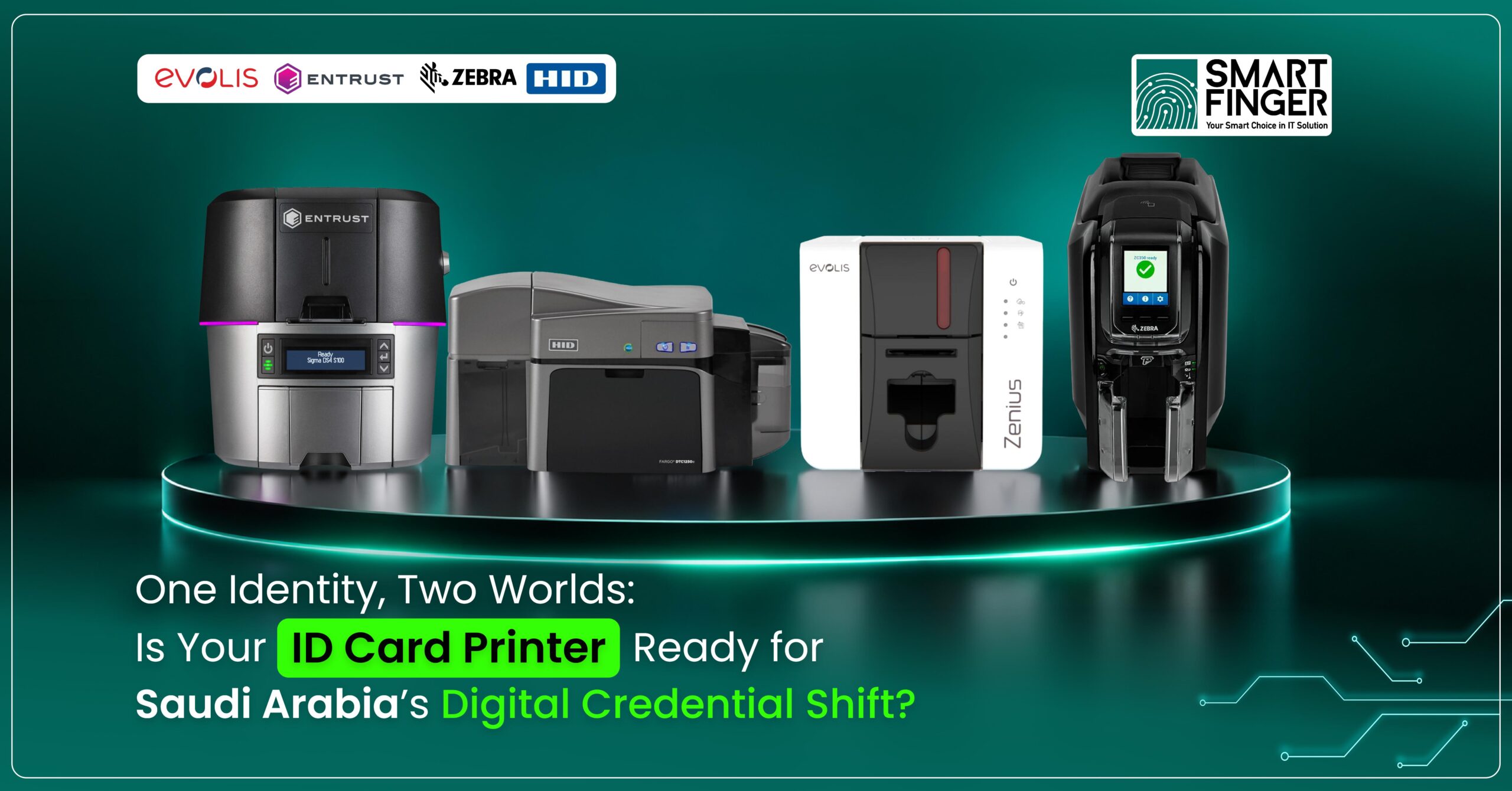
A normal ID card printer can print employee photographs, names, employee numbers and company logos. On the contrary, card personalization enables the printing of unique information assigned to each employee. Such card printers offer colour printing, barcodes, QR codes etc.
Moreover, administrators can enable single-sided or dual-sided printing. Also, they can issue custom layouts for departments, visitors and different access levels.
The role of smart card technology
ID cards can support different modes of access with different technologies.
RFID cards :- Administrators can identify people through radio frequency communication with RFID card printing.
Contactless cards :- Individuals can tap a card against a reader instead of inserting or swiping it.
Smart cards :- These cards have embedded chips that can store or process identification information.
With a smart ID card printer machine, administrators can link access permissions to the organisation’s access management system. Also, some printers offer encryption and authentication features depending on card technology.
Choosing the right printing technology
Each organisation can choose the printing technology based on its security needs.
PVC card printing – It gives professional, durable cards for regular workplace use.
Direct to card printing – The ink is transferred directly onto the card surface.
Retransfer printing – It enables printing onto a film that is transferred onto the card for edge to edge coverage.
RFID card printing – Administrators can print on compatible smart ID cards while preserving chip and antenna functionality.
Encoding – Some options offer magnetic stripes, contact chips and contactless chips encoding modules.
Lamination – This feature enables additional card protection depending on the printer.
More importantly, printing a card and encoding its chip are two different processes. A printer needs the appropriate encoding module, compatible card technology and supporting software to create functional access credentials.
How Smart Finger Helps Organisations Move Beyond Basic ID Card Printing
A professional identity system should do more than print an employee’s photograph. It should support how an organisation identifies people, manages permissions and protects its premises.
We have more than 11 years of experience in supplying security, identification and access control solutions in Saudi Arabia. We have ID card printer solutions for corporate houses, institutions and government offices. In addition to this, our alliance with global brands enables us to provide solutions for organisations of various sizes and printing needs.
The increasing connectivity of Saudi workplaces means that there is a need to match it with identity management. The appropriate printing solution may assist organisations in having reliable physical identification systems.
Upgrade your organisation’s identity management with Smart Fingers ID card printing solutions.
Call us at +966 56 997 2277 or drop an email at [email protected].
Reference Link:
FAQ
Physical identification is necessary for recognition purposes within the workplace, access to certain areas within an organisation, attendance management and identification of employees in restricted zones.
Organisations can utilise secure ID cards that have RFID chips and encryption credentials. They assist in regulating entrance access rights, reducing any unauthorised access.
Take into account the number of prints per day, card durability, whether to print on one side or two, the quality of the colours and encoding as well as compatibility with the current security system.
Yes. PVC cards are good for identifying employees, students, visitors and contractors. They can also include pictures, barcodes, QR codes and compatible access systems.
Yes. Appropriate printers along with encoding modules can be used to create the required cards which can be read by the current access control readers and identity management software.