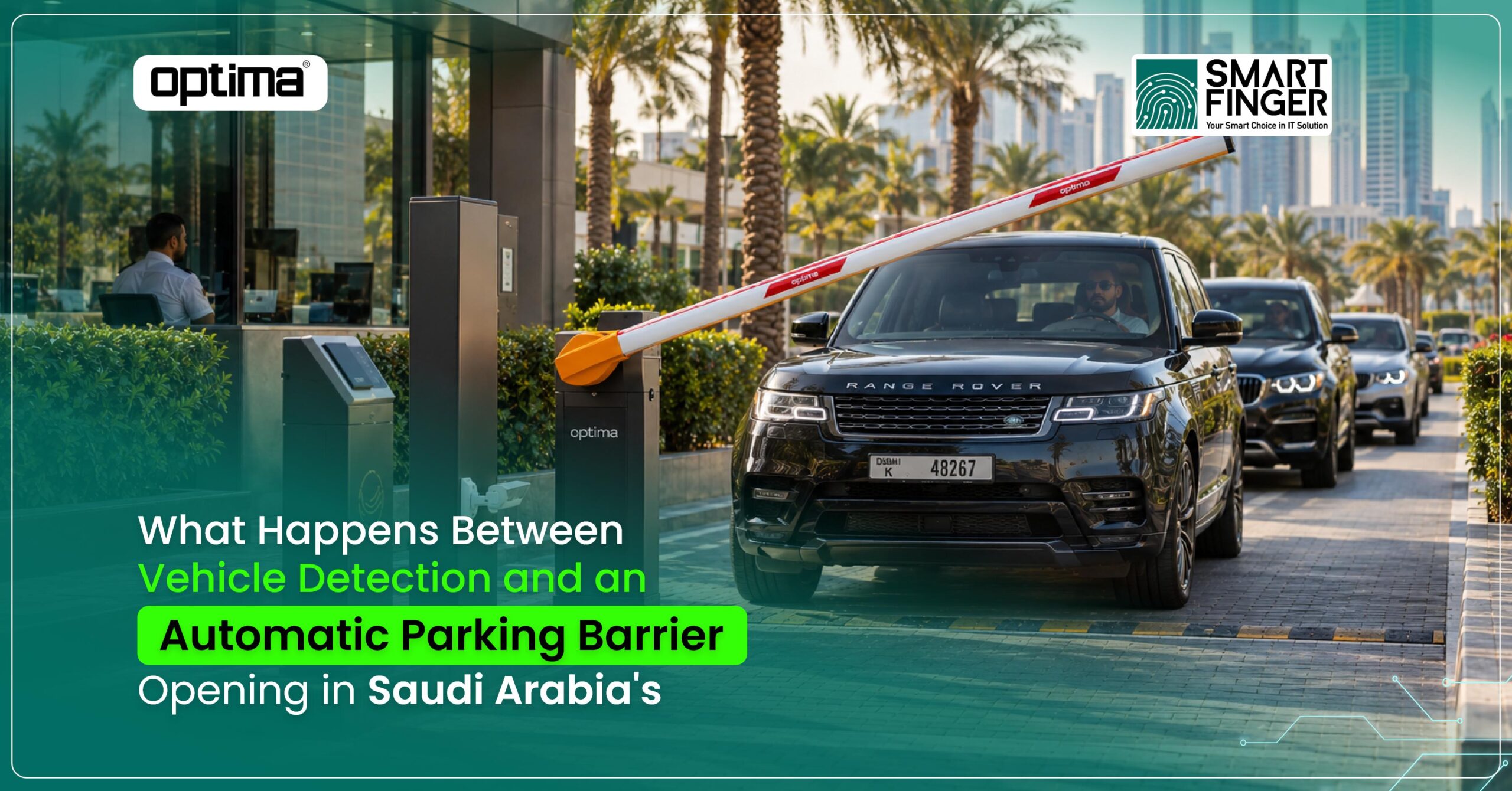
What Happens Between Vehicle Detection and an Automatic Parking Barrier Opening in Saudi Arabia?
How does a parking barrier know when to open?
From vehicle detection to RFID or ANPR identification, what happens behind the scenes? Find out how Smart Finger offers smarter, seamless parking access solutions in Saudi Arabia.
You roll towards a gate, and the arm lifts before you even stop. It feels effortless, almost like magic. Yet an automatic parking barrier makes several decisions at that moment. Each one has to be right, every single time.
Why does that matter in Saudi Arabia? Registered vehicles passed 15.8 million by the end of 2024, a 6.9% rise in one year (Source: Saudi Press Agency). More than one million were newly registered that year. Every extra car adds pressure to the entrance of a mall, tower or hospital. Slow gates create queues, and careless gates create risk.
Smart Finger supplies access control and RFID parking system solutions across Saudi Arabia, and has done so for more than ten years. Our team serves residential complexes, corporate offices and logistics hubs. In this blog, we follow one vehicle from first detection to a raised arm. Then we compare RFID with ANPR and show how the parts connect. Ready to see what happens in those few seconds?
What Triggers an Automatic Parking Barrier to Respond?
Picture a delivery van rolling up to a warehouse gate in Jeddah. Nothing opens yet. The barrier is waiting for proof that a vehicle is really there.
That proof comes from sensors. Three types do most of the work:
Inductive loops: Wires are installed within the road surface to detect vehicles. A metal body changes its magnetic field, and the controller notices.
Infrared photocells: A beam crosses the lane. When a bumper breaks, the system registers presence.
Radar units: These read movement and distance, which helps in dusty or wet conditions.
Detection alone never lifts the arm, though. A parking barrier does not open because a car is nearby. It opens when a controller matches detection with permission.
Imagine the controller as a door keeper with a clipboard. The sensor says someone has arrived. The reader or camera says who. The controller then checks whether access is authorised and signals the barrier operator through a relay to open the barrier.
One more sensor protects whatever sits beneath the arm. This safety loop stops the boom barrier from lowering while the vehicle is in its path. Some sites also add a safety edge, a soft strip that detects physical contact and triggers the arm to stop or reverse.
This layered logic is the foundation of vehicle access control. Detection asks, “Is something here?” Identification asks, “Should it enter?” Safety asks, “Is it clear to move?”
Skip one layer, and problems follow. Tailgating, damaged vehicles and jammed queues sometimes trace back to a missing check.
Smart Finger sets up these layers lane by lane. A residential compound needs different sensitivity than a logistics yard full of trucks. Its team handles on-site configuration, so the timing matches real daily traffic patterns.
Deploy the suitable parking barrier at your facility.
Call Smart Finger at +966 56 997 2277 or drop an email at [email protected] for more information.
RFID or ANPR? How Vehicles Are Identified Before Entry
Now the gate needs a name for the vehicle. Two technologies compete for that job, and they work very differently.
RFID works like a handshake. A UHF tag sits behind the windshield. As the car approaches, a reader sends out a radio signal, and the tag answers with a unique ID. The controller checks that ID against an approved list.
An RFID parking system suits residents, staff and fleet vehicles, since each car carries its own credential. An RFID barrier gate clears those cars without the driver touching anything.
Automatic number plate recognition takes a different route. A camera captures the plate. Software using optical character recognition turns the image into text, then searches a database for a match.
Nothing needs fitting to the car, so visitors, rental cars and pre-registered guests pass easily. Saudi plates carry Arabic letters and Latin equivalents, so camera angle and lighting matter.
So which one wins? Picture a Riyadh office tower. Tenants use tags. Visitors register their plates at reception, and the camera admits them later. One vehicle identification system handles both credentials.
Some larger sites run both checks together. If the tag and the plate disagree, the gate holds and alerts security. That mismatch check exposes borrowed tags very quickly.
RFID: Fast reads, needs a tag, best for regular users.
ANPR: No tag needed, suits visitors, depends on good camera placement.
Smart Finger offers ANPR, RFID cards and mobile app control as options on its smart parking system solutions. Our team helps match the mix to each site’s traffic, budget and user types.
A well-planned automatic parking barrier treats identification as a choice, not a rule. Tags reward your regular users. Plates welcome unexpected visitors.
Smart Finger’s Role in Building Connected Parking Access Systems
Opening the gate is only part of the process. What happens to the data afterwards matters just as much. Every entry creates a record: time, credential, lane and decision.
Smart Finger builds its gates as part of a connected parking access control system, not as standalone units. Readers, cameras and controllers report to one interface. Managers set permissions, read entry logs and automate workflows from a single screen.
Imagine a logistics hub with three gates and 400 drivers. Without central control, each gate keeps its own list. A former driver’s tag stays active until someone updates every controller. With one shared platform, one change revokes access everywhere.
That shared platform is the base of any parking management system. Add occupancy counting, and it starts to behave like a smart parking system. Go further with bay guidance and payment, and you approach a fully automated parking system.
Hardware still matters. Saudi summers punish weak parts. Smart Finger supplies weather-resistant, heavy-duty parking barrier gate models built for heat and dust, then installs and configures them on site.
Then there is the law. Saudi Arabia’s Personal Data Protection Law has been in force since 14 September 2024, with penalties reaching up to SAR 5 million. By mid-January 2026, SDAIA had announced 48 enforcement decisions. Plate images and access logs can qualify as personal data, so retention and access rules deserve early legal attention (Clyde & Co).
An automatic barrier gate can plug into what already exists. Smart Finger’s devices work with your existing access control software, so parking access control grows in steps rather than in one costly leap.
Conclusion
Follow the vehicle once more, from the top. A sensor spots it. A reader or camera names it. A controller checks the list, and a safety loop clears the path. Only then does the arm finally rise.
That whole sequence takes only seconds, yet it depends on careful planning. Sensor placement, identification method, data rules and hardware quality all shape the outcome.
Smart Finger brings those pieces together for sites in Riyadh, Jeddah and across Saudi Arabia. Our team supplies the hardware, connects it to existing access control, and provides technical support. Planning a new gate, or replacing one that keeps failing? A short, honest conversation about your traffic, users and site conditions is a good place to begin.
Every automatic parking barrier should open for the right vehicle and stay shut for the wrong one. Speak with Smart Finger, and get that balance right from the very first day.
Deploy the suitable parking barrier at your facility.
Call Smart Finger at +966 56 997 2277 or drop an email at [email protected] for more information.
Reference Link
FAQ
Sensors do the detecting. Inductive loops, infrared beams or radar report a vehicle's presence to the controller. The controller then waits for a valid credential before it lifts the arm.
RFID suits residents, since each car carries a tag. ANPR suits visitors. Many compounds pair an ANPR parking management system with tags, so both groups get in without stopping at a desk.
It depends on the model. Many controllers accept a battery backup, and many arms include a manual release. Confirm both options before you buy.
They can. Under the PDPL, you need a lawful basis for collecting personal data. Where notification is required, breaches must be reported to SDAIA within 72 hours. Limit who sees footage, set retention periods and consult legal counsel (Source: DLA Piper Intelligence).
Usually within a few seconds, though arm length changes the speed. Shorter arms move faster. Check the specification against your peak-hour traffic.