Who Gets In, When and How? Understanding SALTO Door Access Control in Saudi Arabia
Who really controls your doors?
A card, phone or PIN may decide who gets in. But what happens behind that simple entry? Explore how SALTO makes access smarter for Saudi businesses.
Everyone in your business does not need the same door access. Also, giving everyone the same key is rarely a smart security strategy.
Businesses in Saudi Arabia may have employees, managers, visitors, contractors and cleaners who require different levels of access. If the main credential is a key, it can be copied, lost, shared or difficult to track. This is where SALTO door access control becomes relevant as a smarter way to manage who can enter specific doors and when. The access control market in Saudi Arabia is expected to reach a projected revenue of US$ 409.8 million by 2033 (Source: Grand View Research).
Mainly, SALTO allows businesses to move from a simple “locked/unlocked” approach to controlled user-specific access. It helps Saudi facilities to answer questions such as who can enter, when they can enter and how they authenticate. The real advantage begins when one door can recognise that different people need different permissions.
One Door, Different Users: How SALTO Controls Access
A manager may need access all day, an employee only during working hours and a contractor may need access to one room for a limited period. Why should all three have the same access? How can SALTO door access control manage different types of access permissions?
Different users, different permissions
SALTO gives employees access to the areas they actually need. Also, managers can have broader access, while contractors can receive limited access. Simultaneously, visitors can be given controlled or temporary permissions.
Access can be time based
Permissions can be linked to specific days or times with SALTO. For example, an employee can enter during working hours but not after office hours. This reduces the need to manage keys for every schedule change manually.
Access can be door-specific
Someone may be authorised for the main entrance but not the server room. Another employee may have access to a particular department. This creates a controlled SALTO door system rather than giving everyone unrestricted entry.
Credentials are authenticated before access is granted
The user can use his/her card, mobile key or some other accepted credential. The SALTO lock authenticates the user’s permissions and then grants or denies access based on the user’s permissions.
Electronic rather than traditional key management
SALTO electronic locks help businesses manage permissions digitally without depending entirely on physical keys. If an employee changes departments or leaves the organisation, their access permissions can be updated or removed.
Different hardware for different locations
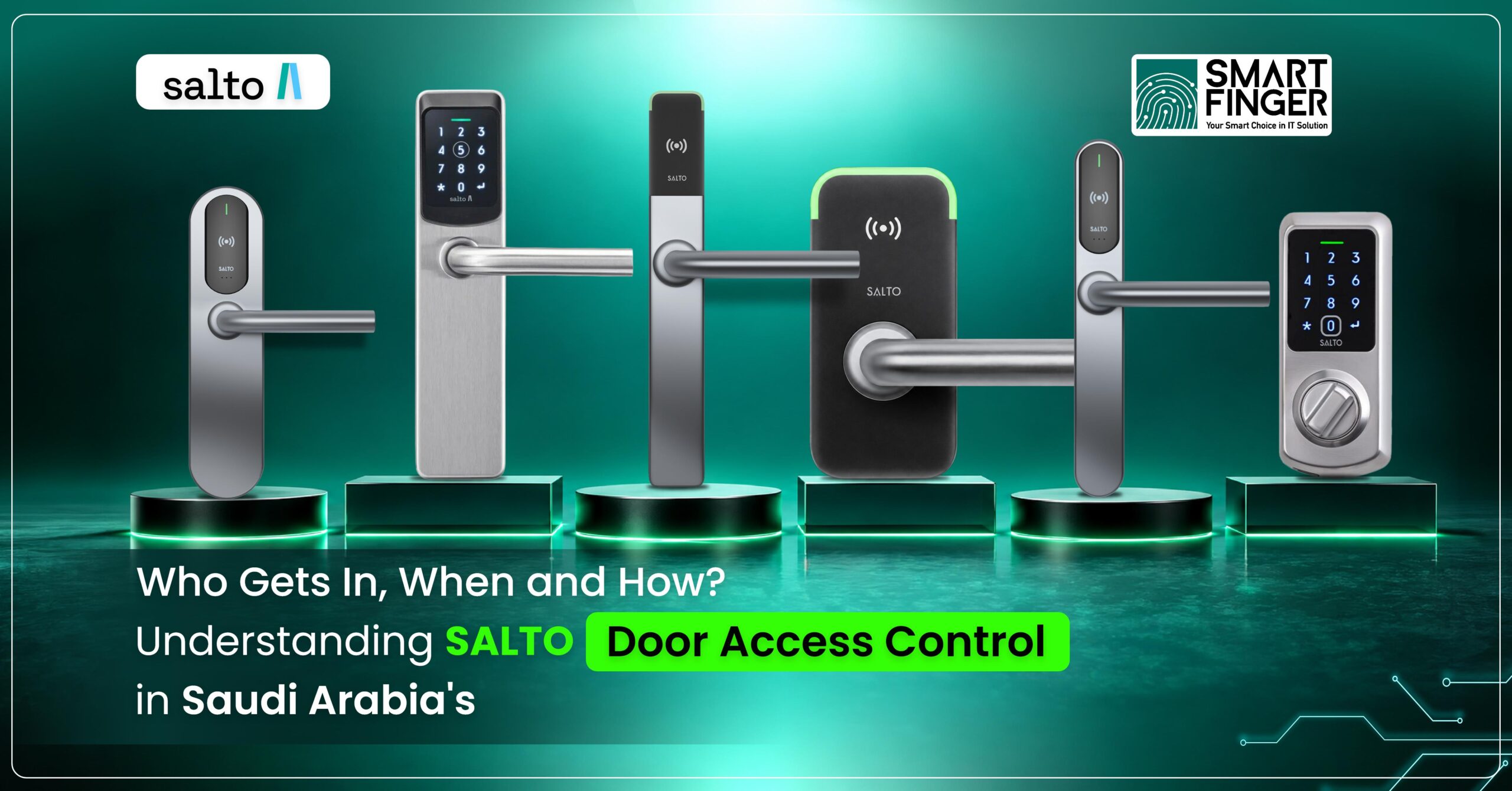
Businesses can use SALTO wireless locks, electronic locks, readers and controllers depending on the building. A SALTO wall reader can be used where the access point requires a separate reader. On the other hand, a SALTO door controller can support access at certain entry points.
Tighten the security of your facility with SALTO and Smart Finger.
Call us at +966 56 997 2277 or drop an email at [email protected].
Phone or Card? Exploring the Credentials Behind SALTO Access
Access control is not only about deciding who can enter a room. It is also about choosing how they prove their identity. With SALTO, businesses can use different credentials such as cards and smartphones to make authorised entry more convenient and controlled.
- SALTO cards
For many businesses, the simplest access credential is still the one employees already know how to use: a card. SALTO cards work as credentials for authorised users. When a user presents the card to a compatible SALTO card reader, the system checks whether that credential has permission for that particular door. Such cards can be beneficial for offices, hotels and commercial buildings.
- SALTO mobile key
Compatible smartphones can be used as a digital credential. This can reduce dependence on physical cards for suitable users. Mainly, employees can use their phone to interact with compatible SALTO access points. 99.4% of internet users accessed the internet through mobile phones in Saudi Arabia in 2024 (Source: CST). This highlights the importance of mobile key adoption.
Its advantages
Less dependence on physical cards.
Useful for employees who already rely heavily on smartphones.
Easier to integrate apps into a more digital workplace.
- PIN based access
Authorised users can enter a pre assigned PIN to gain entry. Different users can be assigned different codes or access permissions depending on the specific SALTO solution and configuration.
How to choose the right credential for the business?
Card-based access may suit organisations where employees already use ID cards. On the other hand, mobile credentials may be helpful for businesses looking for a more smartphone-oriented experience. PIN-based access can be useful where businesses want an alternative to carrying a card or smartphone. Large organisations may use a combination of credential types, but the choice should be based on:
Number of users
Type of facility
Security requirements
Employee behavior
Visitor access
Existing access control infrastructure
Choosing the right credentials is only one part of the equation. Turning that choice into a reliable access control system requires the right technology, planning and implementation partner.
How Smart Finger Helps Saudi Businesses Implement SALTO Access Control
Buying a smart lock is one thing. Building an access system that works smoothly across an entire facility is another.
Smart Finger, with years of experience in implementing Salto door access control systems in Saudi Arabia follows a systematic approach. The first stage is understanding the business requirements.
We analyse which doors need protection, who needs access, what time access should be permitted, whether there are restricted areas and whether visitors or contractors are involved. Then we offer a solution based on these requirements rather than simply installing hardware.
We then help businesses determine where different components may fit, such as SALTO door locks, SALTO wall reader and SALTO door controller. Users can be organised according to roles. Moreover, access permissions can reflect departments, working hours and restricted areas.
More importantly, SALTO solutions can help businesses move beyond traditional keys. Businesses can connect the system to the broader world of secure, convenient and manageable building access. Ultimately, we help businesses translate software technology into a practical access control setup.
Tighten the security of your facility with SALTO and Smart Finger.
Call us at +966 56 997 2277 or drop an email at [email protected].
FAQ
They are used in Saudi business places to manage a company's entry policy. They can be installed in office buildings, hotels, healthcare institutions, educational boards and many other commercial places that need to keep a certain level of control over the entries.
A SALTO lock system makes it possible to give access permissions according to different users, doors and schedules. For instance, employees could gain access to specific doors during specific hours, while some areas remain closed to unauthorised personnel.
Yes. With the compatible SALTO solutions, mobile credentials can be implemented whereby authorised individuals can access through the use of their cell phones rather than access cards. This is convenient especially for the staff.
Yes. A schedule for permission can be set based on the type of SALTO solution. Thus, you will be in control of the people accessing your system and those who are not allowed.
SALTO can be suitable for places where several people need access to certain doors, such as in hotels, offices and commercial buildings. Such places can use many different credentials and locks to give access to different doors with different levels of workers.