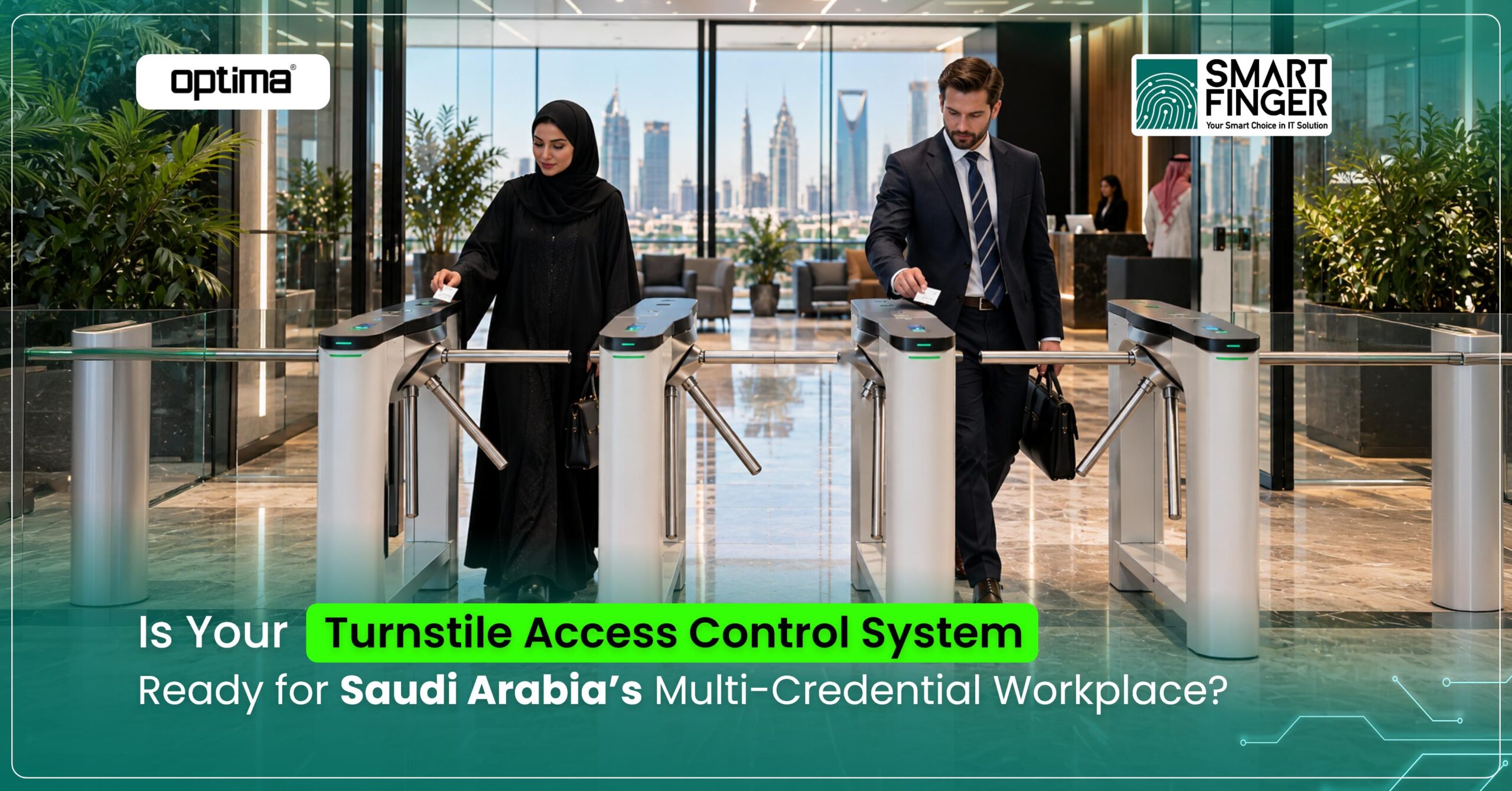
Is Your Turnstile Access Control System Ready for Saudi Arabia’s Multi-Credential Workplace?
Can your turnstile handle every credential your Saudi workplace uses?
It should. From RFID cards and biometrics to mobile credentials and QR codes, the right turnstile can manage busy entrances while helping prevent tailgating and unauthorised access.
517 foreign companies earned regional headquarters licences in Riyadh during 2024, beating the Kingdom’s target of 500. Each of those offices may have a lobby. Each lobby needs a turnstile access control system that suits very different people (Source: Sharikat Mubasher).
Mainly, those people carry different credentials. One employee taps a card. A visitor shows a QR code. A contractor holds up a phone. A new hire enrols a fingerprint. Will your gates recognise every one of them?
Smart Finger has worked in Saudi Arabia for over ten years. Also, we know where entrances fall short. Many fall short quietly. They work on day one, then struggle when headcount doubles or a new credential arrives. Read this before your next site walk-through, and keep a pen in hand.
RFID, Biometrics and Mobile Credentials: What Should Your Turnstile Support?
Picture a Riyadh office tower at 8:45 on a Sunday morning. Three hundred people want to get in. Moreover, each holds something different.
Your gates must read all of it. Here is what to look for.
RFID cards and fobs
Cards remain the workhorse. Ultimately, a well-planned RFID access control system uses encrypted formats like MIFARE DESFire. However, most of the old proximity cards are easy to clone. A card reader turnstile should also accept your existing badges, so nobody reissues thousands of cards.
Biometrics
Fingerprint and face readers verify the person, not just the badge. Look for liveness detection, which rejects photos and silicone fingerprints.
Biometrics also carry legal weight. Saudi Arabia’s PDPL treats biometric data as sensitive, and full enforcement began on 14 September 2024. Employers may need explicit employee consent and a published privacy policy. Storing templates on the card, rather than a central server, may limit exposure (Securiti AI).
Mobile credentials
Phones act as keys through NFC or Bluetooth Low Energy. Staff lose cards often, phones rarely. Will your next employee’s phone work on day one? Visitors can also receive passes remotely, well before they reach reception.
QR codes
These suit one-day contractors because they expire by the access control system.
One technical check matters more than most. Ask how readers talk to the controller. OSDP is two-way and OSDP Secure Channel provides encryption. The older Wiegand protocol is neither, so intruders can tap the cable.
Choose turnstile gates that can accept credentials through one controller. Adding a method later then means a software change, not new hardware. So treat the gate as part of an access control gate system, linked to your wider security systems.
Install the right turnstile access control system for your facility.
Call Smart Finger at +966 56 997 2277 or drop an email at [email protected].
How Turnstile Integration Helps Prevent Unauthorised Access
A guard at a desk sees faces. Also, a gate sees credentials. Neither catches everything alone.
The most common breach is quiet. Someone simply follows an authorised person through. Security teams call it tailgating. Picture a delivery rider trailing a staff member into a finance floor, parcel in hand.
Integration closes that gap in layers.
Optical sensors along the passage track each body. If two people cross on one valid read, the gate blocks the second and sounds an alarm.
Anti-passback stops a card being passed back to a friend outside. A badge that entered cannot enter again until it exits.
Fail-safe and fail-secure modes decide what happens in a fire or power cut. Fail-safe frees the lanes for escape. Fail-secure keeps them locked. Your fire plan should guide the choice.
Event logs record every attempt, including failed ones. Investigators rely on them after an incident.
Integration with the wider access control system matters just as much. A terminated employee’s access should end everywhere in one action, not door by door.
A well-configured turnstile access control system turns a lobby from a polite suggestion into a real checkpoint. Smart Finger pairs gates with readers and controllers.
Ask a simple question: who walks through your lobby after hours? Cleaners, couriers, night-shift engineers. Each needs a rule the gate can enforce, such as time-based schedules. Write those rules down before installation begins.
Not every site needs the same barrier. Access control turnstiles with waist-high arms can be suitable for staffed offices. Taller security speed gates, with swinging or sliding flaps, suit unstaffed lobbies. A speed gate system can also place a wide accessible lane beside standard ones.
Choosing the Right Turnstile Access Control System With Smart Finger
Buying a gate is easy. But buying the right one takes a few honest questions. Good turnstile access control starts with your people, not the hardware.
How many people arrive at once? Throughput influences queue size and the number of lanes required. Think about your busiest periods, average verification time and anticipated traffic volume. With adequate capacity, a system should keep queues flowing without generating unnecessary bottlenecks.
Imagine 600 staff arriving within 30 minutes. That is 20 people a minute. One verified lane handles 25, leaving almost no margin. Two lanes feel comfortable.
Does it fit the lobby? Consider the turnstile’s overall dimensions, passage width and available floor space. Mark emergency routes and accessible lanes on your floor plan before selecting the equipment.
Which credentials today, and tomorrow? The gate supports RFID, biometric and QR readers. Pick a controller with an open API, so your HR system adds and removes staff automatically.
Who supports it afterwards? A dependable turnstile supplier stocks spares, answers calls and visits the site. Smart Finger has worked in Saudi Arabia for over ten years, from its Riyadh office.
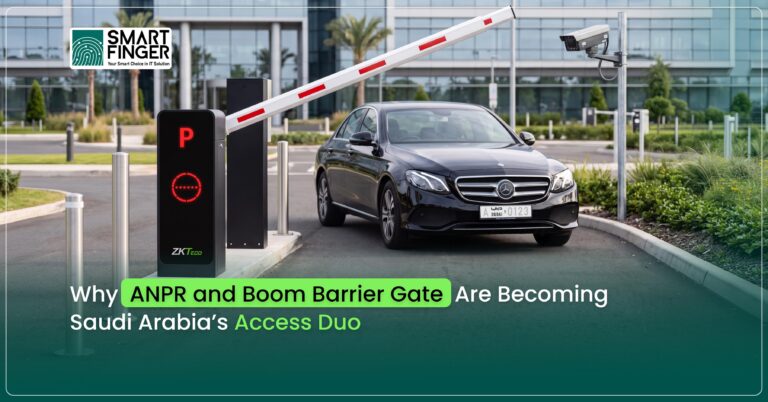
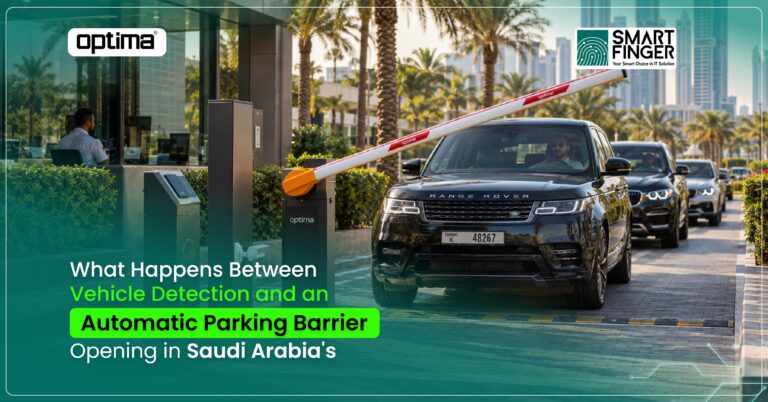
Think beyond the lobby, too. Your parking lot needs a gate barrier that lifts quickly. Smart Finger partners with prominent brands to bring turnstile systems. Linked with lobby gates, these parking gate systems form one gate barrier system with a single identity record. Even the security gate at a compound entrance can feed the same record.
Finally, ask for a live demonstration. Watch the gate with a card, a phone and a QR code. Then test two people crossing on one pass. Does the alarm sound? Does the lane stay closed? Five minutes of testing reveals more than any brochure. Ask any vendor for that demonstration, including us.
Ready for the Multi-Credential Workplace?
Saudi workplaces no longer run on one credential. Cards, fingerprints, faces, phones and QR codes now share lobby, often within the same minute. Moreover, gates that read only one of them create queues, workarounds and blind spots. Also, gates that read all of them, and log every pass, give security teams something rare: certainty.
Start with a simple audit. Count your credential types. Check your PDPL obligations. Also, measure your peak-hour flow. Then test any shortlisted gate with two people and one pass. The cost of waiting is rarely dramatic. It shows up as a tailgater, a failed audit or a crowded lobby.
If you want a second opinion, Smart Finger can walk your site with you. We will map the entrances, the credentials and the risks. Then we will say plainly whether your current turnstile access control system is ready.
Install the right turnstile access control system for your facility.
Call Smart Finger at +966 56 997 2277 or drop an email at [email protected].
FAQ
Yes. Standard turnstiles use rotating arms. Speed gates use fast-moving flaps guided by sensors. They move people faster and suit premium lobbies. Choose by traffic volume and building style.
The reader sends the scan result to a controller. If it matches an authorised record, the flaps open. Otherwise the lane stays closed and the attempt is logged.
That depends on configuration. Many sites set lanes to unlock for evacuation. Confirm the setting against your fire safety requirements, and ask about battery backup.
Price depends on lane count, credential types, finish and system integration. A site survey gives a realistic figure. Request a quote with your floor plan and headcount.
Often yes, if the reader supports your card technology. Bring a sample card to your supplier for a quick compatibility test.